Why You Can't Stop Eating: The Nervous System Connection Behind Food Noise
Jul 01, 2026
You know what to eat. You know what you “should” do. And yet somehow, after promising yourself that this week will be different, you find yourself standing in the kitchen halfway through a bag of chips wondering, What is wrong with me?
That question, the one so many people quietly carry around, is built on a misunderstanding. If you have spent years believing your problem is a lack of discipline, then you have been trying to solve the wrong problem.
Most people think weight loss is about knowledge. And it’s built on the premise that once you know better, you will automatically do better. But knowledge is not the issue. If information were enough, nobody would struggle.
The truth is that your brain and body are running thousands of patterns every day without your conscious awareness. Your nervous system is constantly scanning your environment and asking one question. Am I safe?
It’s not asking, "Am I eating enough protein?" Not, "Did I hit my macros?" Not, "How many calories are in this?" It’s got one primary mission and that is, safety.
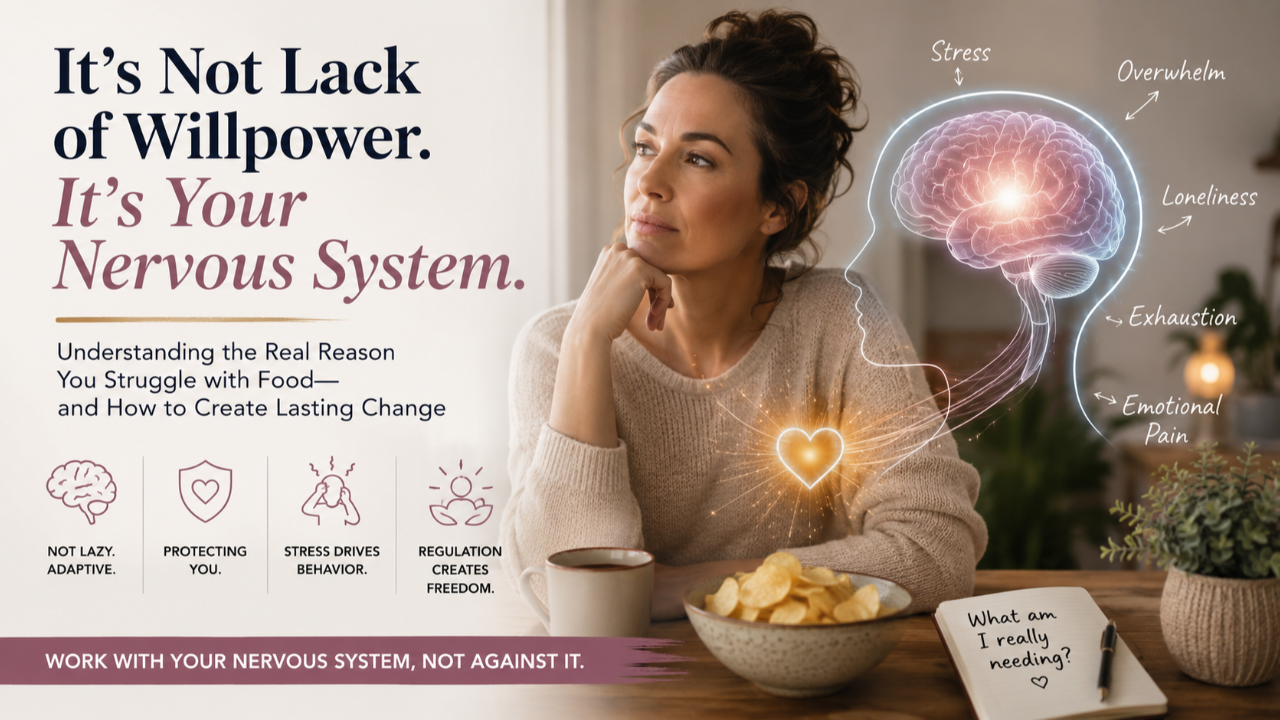
When your nervous system experiences discomfort, stress, loneliness, overwhelm, or emotional pain, it codes all of those experiences the same: “this doesn’t feel good”, in other words, this doesn’t feel safe. It then searches past records for what to do in those scenarios, familiar patterns that led to a reduction of the discomfort. For many people, that familiar solution became food.
Not because you are weak. Not because you lack motivation. But because somewhere along the way, food became a solution. A coping strategy the nervous system got used to as a way to deal with discomfort.
Here is the perspective shift most people never hear. Your patterns are not random. They are adaptive.
Adaptive does not mean healthy. It does not mean ideal. It simply means your brain and body learned that this behavior helped you overcome discomfort at some point, and therefore this behavior “worked”.
Maybe food soothed loneliness. Maybe it became your reward after hard days. Maybe it offered comfort during stressful seasons. Some have even described their relationship with food to me as their “best friend”. Over time, those experiences got wired into your nervous system.
So even decades later, when life feels overwhelming, your brain reaches for the same solution it has always known. Then we call that self sabotage.
But what if it is actually self protection?
Think about what happens every Monday. You decide that you are not eating chips anymore. You’re determined to stick to the plan. But the stress of your daily life is still there. Your loneliness is still there. Your exhaustion is still there. Nothing else changed except that you vowed to remove the coping strategy your nervous system has learned to depend on.
And your nervous system does not love that.
In fact, it revolts.
What people are calling food noise these days is not proof that you are addicted or broken. It is often a nervous system desperately trying to return to what feels familiar. Removing the coping strategy of food without replacing it is like taking away a toddler's favorite blanket and expecting them not to protest. Of course there is resistance. Of course your cravings get louder.
Your nervous system is simply asking, "If not this, then what?"
Instead of asking, "Why can't I stop eating?" try asking a different question.
- Has my nervous system learned to use food as a coping strategy?
- If so, who/what/when/where does my system turn to food to cope?
- What is my brain and body trying to protect me from? And what do I really need instead?
These questions can create compassion instead of shame. Curiosity instead of criticism. Because eating is the response. The deeper question is what it is responding to.
After working with thousands of people, one truth became impossible for me to ignore. People do not struggle because they are lazy. They struggle because they are trying to remove old coping strategies without examining why the coping strategy is being deployed in the first place.
That is why traditional diets fail. They focus on behavior while ignoring the nervous system driving the behavior.
When you learn how to regulate your nervous system by building flexibility, capacity and resilience, and create new ways of responding to discomfort, something remarkable happens. Healthy choices stop feeling like a battle. You naturally stop obsessing about food. The noise quiets down. Eating differently becomes less about willpower and more about alignment.
Perhaps your struggle has never been about willpower. Perhaps your brain and body have simply been doing what they learned to do in order to protect you. And if that is true, then maybe the answer is not to fight yourself harder. Maybe the answer is to understand yourself more deeply.
If you have spent years wondering why you know exactly what to do but still cannot seem to do it, I promise you do not need another diet. You need to learn how to work with your nervous system instead of fighting against it.
Lasting change rarely comes from force. It comes from creating enough safety, flexibility, and resilience that you no longer need food to carry the weight of everything else.
This understanding has transformed the lives of thousands of people I have worked with over the past two decades. It is also the foundation of the work we do inside my signature program “The Shift”, where we learn to work with the nervous system instead of against it, so that healthy choices begin to feel less like a battle and more like a natural expression of who you are becoming.
What's Next?
If this is resonating with you, if you're beginning to wonder whether your struggle with food has never really been about willpower, then I invite you to take the next step.
The truth is, understanding that your patterns are adaptive is just the beginning. The next question becomes, "How do I actually create change?"
That's exactly what I teach inside my free workshop, Master Your Weight Loss. I'll show you why traditional weight loss advice has it backwards, what is really driving your patterns with food, and how to work with your nervous system instead of fighting against it so that change becomes sustainable.
Because if you're anything like the thousands of women I've worked with over the years, you don't simply want to lose weight. You want freedom. You want to stop obsessing over food. You want to trust yourself around food again. You want peace in your own body. And that requires a different approach.
👉 Click here to watch Master Your Weight Loss.
If you enjoy understanding the deeper "why" behind your behaviors, I also dive into these topics each week on the Brain Powered Weight Loss Podcast, where I unpack the science, the stories, and the practical tools that help create lasting transformation.
🎧 Listen on your favorite platform. Simply search Brain Powered Weight Loss Podcast or click here.
Let's Keep the Conversation Going
If something in this post resonated with you, I hope you'll take one thing with you:
There is nothing wrong with you.
Your brain and body have been trying to protect you in the best way they know how. And when you understand that, you can stop fighting yourself and start building the safety, flexibility, and resilience that make lasting change possible.
As a licensed psychotherapist, behavior change specialist, and expert in the neuroscience of lasting transformation, I've helped thousands of people regulate their nervous systems and finally feel at peace with food and their bodies. Not through willpower, but through proven, science backed methods that create sustainable long-term change.
👉 Ready for deeper support? I'd love to hear from you. Send me an email at [email protected].
And if you're looking for a safe place to heal your relationship with food, body, and self, you're in the right place.
I'm so glad you're here.