Master Your Weight Loss LIVE Workshop Recap + Reflections – Fall 2026
Sep 17, 2026What if the reason you keep struggling with your weight isn’t that you don’t know what to do—but that you’ve been trying to change the wrong things first?
We just wrapped another Master Your Weight Loss LIVE Workshop, and this time I kept coming back to something I have seen over and over in my 25 years of doing this work: women know a LOT about weight loss. They know protein. They know calories. They know carbs. They know diets. They know exercise. They know what they “should” eat. Many of them could probably teach a class on it. And yet, they keep telling me some version of the same thing: “I know what to do. Why can’t I get myself to keep doing it?”
That is the question that has driven my career for 25 years. What are the driving factors behind why it’s so hard to change, even when we’re deeply committed to it. Because if more information about dieting were the answer, most of the women who come into my world would have solved this problem 20,30 years ago. Instead, many have spent decades cycling through losing weight, regaining it, promising themselves this time will be different, trying harder, falling off again, and eventually wondering, What is wrong with me?
Over the course of my recent workshop, I wanted to show them what is actually happening underneath that cycle and, more importantly, what we can do about it.
The Problem With Starting With Food
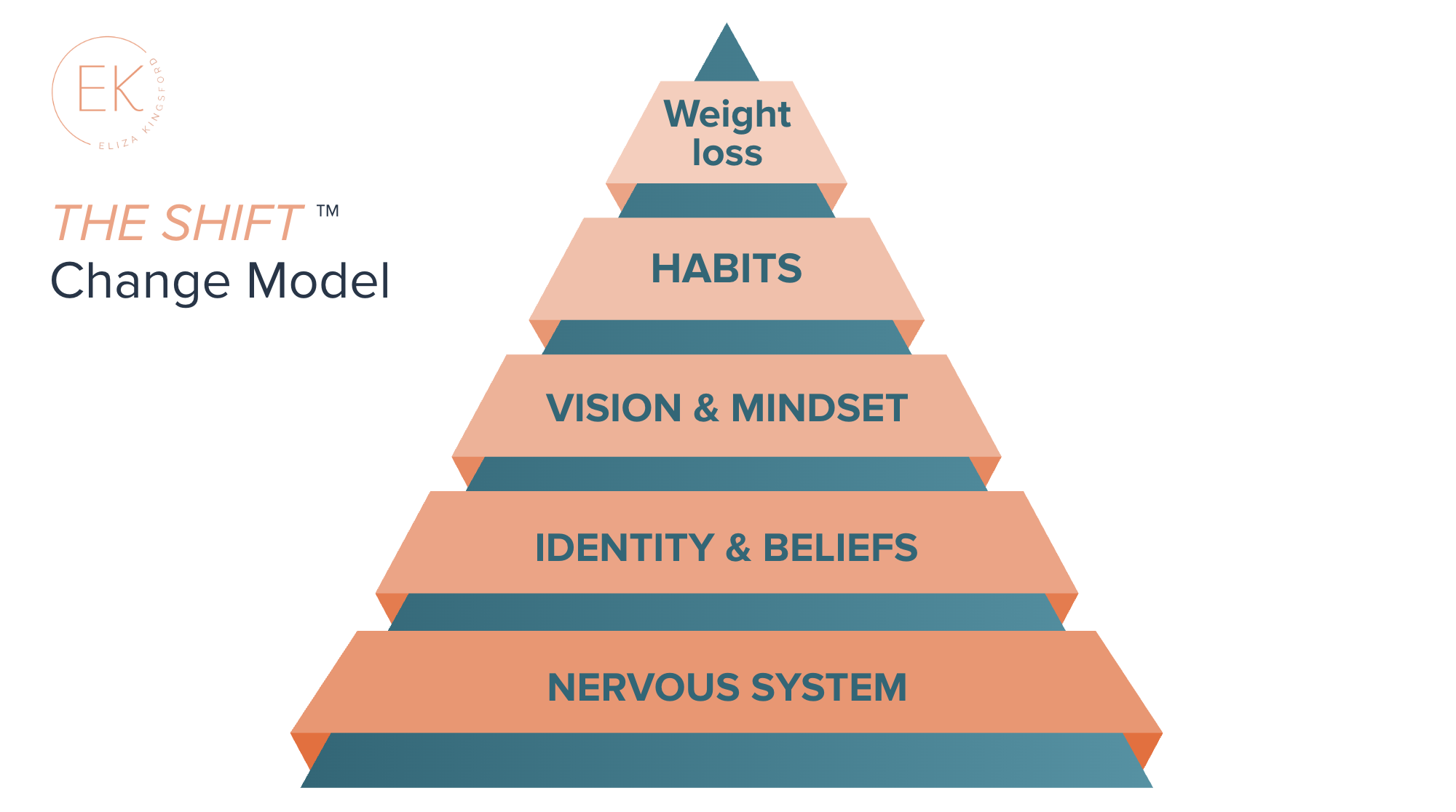
Think of the pathway to losing weight like a pyramid. Most weight-loss approaches teach you to start at the top: change your food, change your exercise, change your calories, change your macros, change your plan. I call this the behavior level. And it sits right near the top of the pyramid. Down lower are the systems that determine whether you can actually carry out those behaviors consistently: your nervous system, your beliefs and identity, and your habits.
This is where my Leaky Bucket analogy comes in. You can keep pouring more information, plans, rules and effort into the top of the bucket. But if there are holes in the bottom of the bucket—chronic nervous-system dysregulation, an identity that conflicts with what you say you want, and habits wired around familiarity—all of your effort is going to leak out through the holes in the bottom of your bucket. Then you conclude that you failed, when the truth is you haven’t actually addressed what was driving the behavior.
Each day of the workshop I taught a concept, rooted in the science of the nervous system that illustrates how you’ve been taught to approach weight loss incorrectly, resulting in a bunch of holes in the bottom of your weight loss bucket that you keep trying to fill with diet and exercise.
Day 1: Food Is Often the Symptom, Not the Cause
Day 1 began with the foundation: the nervous system. One of the most important distinctions I made during this workshop was that the goal of nervous-system work is not to be regulated all the time. You aren’t supposed to walk through life permanently calm. Your nervous system is designed to respond to the environment around you. Something stressful happens? Your system should respond. Something frightening happens? Your system should respond. Something heartbreaking happens? Your system should respond.
The problem is when chronic stress, overwhelm and past experiences have trained the system to remain on high alert—or to move into shutdown—long after the immediate situation has passed, or if the system is misinterpreting a current situation incorrectly. So the goal isn’t actually regulation. The goal is resilience and flexibility: the ability to respond to what is happening and then find your way back.
And this matters tremendously for food. When your nervous system is dysregulated, food can become one of the ways your system has learned to cope with how you feel. You’re stressed, so you eat. You’re overwhelmed, so you eat. You’re lonely, exhausted or anxious, and you eat. Do that enough times and eventually the sequence becomes so automatic that it can feel like the food itself is controlling you.
Which is why one of the central messages from Day 1 was: You cannot outsmart a dysregulated nervous system. You can white-knuckle your way through it for a while. You can force yourself to follow the plan. But if your bottom-up signals are repeatedly pulling you toward an old protective behavior, simply demanding more discipline from yourself doesn’t solve the underlying problem. We have to teach the system another way.
One participant captured this beautifully in her homework: “I’ve always known that something was keeping me from being able to “think” myself from picking up the cookie or taking the next bite.” THAT is the missing piece so many women have been searching for. Not another rule about whether or not they can have the cookie. Understanding what happened before you even reached for it.
The Diet Cycle May Have Taught Your Brain to Expect Failure
There was another piece of Day 1 that I think is incredibly important for anyone who has dieted repeatedly. Think about the familiar cycle: you become frustrated with your weight and your body, you find a new plan, you get excited, you’re determined to follow it, and maybe you do for a while. Maybe you lose weight at first. But then, something happens, you stop following it, the weight comes back, you feel disappointed in yourself, until eventually you start another plan.
Now ask yourself: How many times have you done that? Because your brain is predictive, it uses what has happened before to anticipate what is likely to happen next. So after enough trips around this cycle, even failure itself can become familiar.
The first time you diet, your brain doesn’t know how the story ends. After the 4th, 6th or 20th attempt? It has data. And that can create what’s called learned helplessness. You aren’t beginning the next diet with a blank slate, even when you convince yourself you are. You’re beginning it with years of accumulated evidence saying, I know how this goes. And when the brain learns how to predict the outcome, it wants to do whatever it can to help the prediction along! Including increasing cravings, appetite and food noise. Decreasing motivation to move and generally trying to shortcut your diet process to skip to the end already……failure.
This isn’t a failing on your part. Your brain is simply doing what it evolved to do. It thinks it’s keeping you alive by doing this. That realization changes the question. Instead of asking, “Why can’t I stick to anything?” we can begin asking, “What has my brain learned to expect and how do I teach it something new?” That question can put you on the right path toward change.
Day 2: Your Behavior Follows Your Dominant Beliefs, Not Your Desires
Day 2 moved us into beliefs and identity, and this is where things got really interesting. You can genuinely, desperately, sincerely want to lose weight. But wanting something does not automatically mean your system believes it is possible or safe.
The key idea from Day 2 was: If your desire does not match your dominant belief, your behaviors will not be consistent.
Let’s make that concrete. Imagine that consciously you believe, I want to lose weight. But underneath that desire sits a slew of evidence for the opposite. You think, Nothing ever works for me. I’ll just gain it back. I’m not disciplined. I can’t trust myself around food. Or even, It isn’t safe for me to be in a smaller body.
Your conscious desire says go. Your dominant belief says stop. And then you spend years confused about why your behavior seems inconsistent.
During the workshop, one participant gave us an incredibly clear example. She associated being thinner with experiences of men treating her disrespectfully. Think about the conflict that creates. Consciously: I want to lose weight. Underneath: A smaller body isn’t safe. If safety is the brain’s priority, which message do you think is going to have more influence?
This is why simply repeating, “I want to lose weight,” isn’t enough. We have to uncover what the system actually believes about the thing you say you want. Then we can begin updating those beliefs instead of fighting the behaviors they create.
You May Not Be Self-Sabotaging at All
This is one of the perspective shifts I most want every woman to understand. What you call self-sabotage may actually be your brain doing exactly what it has learned to do. It is trying to keep your experience congruent with what you believe.
If your belief is, I always fail at this, then success would create incongruence. If your belief is, I can’t trust myself around food, then behaving peacefully around food is unfamiliar. If your belief is, Being smaller isn’t safe, then behaviors that prevent you from becoming smaller make sense to the system.
Beliefs are not truth. They’ve been learned. And learned patterns can be updated. It’s the difference between fighting yourself and truly aligning yourself.
Day 3: Your Brain Likes What It Knows, Even When You Don’t
On Day 3 we added the final fundamental: habits. I explained it this way: “If I did it before and it kept me alive, I should do it again.” That is essentially your brain’s modus operandi, MO.
Your brain has an enormous amount to manage every day, so it evolved to automate as much of your life as possible. You probably put your clothes the same way each day without even realizing it. You have a familiar morning routine. You take familiar routes. And you have familiar responses to stress, boredom, frustration and exhaustion. Maybe one of those responses is eating.
The brain isn’t stopping to evaluate whether that habit is helping you reach your current goals. It knows: We’ve done this before. I know what happens next. This is predictable. And predictability conserves energy and signals familiarity.
This is why dramatic attempts to become a completely different person on Monday so often backfire. Suddenly we’re cutting out foods, changing routines, exercising differently, tracking everything and demanding that our brain abandon it’s well-worn path of familiarity. And then we’re surprised when something inside us starts screaming: GO BACK. STOP DOING THIS!
The old path may not be where you consciously want to go, but it is the path your brain already knows. Lasting habit change means creating a new path in a way the brain and nervous system can actually tolerate—and then walking it enough times that it becomes familiar.
Stop Focusing On What You Want to Lose
This led to another important question on Day 3: who are you becoming? Weight loss keeps our attention trained on what we want to get away from—weight, food problems, the body we don’t want, the habits we hate. But eventually we have to give the brain somewhere to go.
What does the person you’re becoming experience? How does she care for herself? How does she respond when she has a difficult day? What does her relationship with food feel like? How does she move? What does she believe about herself?
Because this work is not simply about removing unwanted behavior. It’s about becoming someone for whom the new behavior makes sense. That’s the difference between information and embodiment. Knowing something doesn’t change you. Repeatedly experiencing and practicing another way of being does. True, lasting change is experienced in the body, not learned in the mind.
The GLP-1 Conversation We Need to Be Having
I also spent time on Day 3 talking about GLP-1 medications because, frankly, we can’t have an honest conversation about weight loss in 2026 without talking about them. My position is intentionally nuanced. I am GLP-1 neutral.
There are things I love about these medications. For many people, they can make eating less much easier. They can reduce food noise and appetite and make it easier to say no to food that doesn’t serve you. And if a GLP-1 is an aligned medical decision for you, I want you to hear this from me: I love anything that makes something this difficult easier for you.
But easier doesn’t mean transformational. A medication that reduces the drive to eat doesn’t automatically resolve the nervous-system signal that previously drove you to food. It doesn’t automatically change the belief, I’m not safe. I’m not worthy. I always fail. And it doesn’t automatically build a new identity or teach your nervous system another response.
That’s why I see GLP-1s as a tool that can complement the foundational work, rather than a replacement for it. If a tool frees up mental energy that used to be consumed by food noise, wonderful. Now what can we do with that space? Can we learn what your nervous system has been communicating? Can we change the beliefs that have been driving behavior? Can we build habits that can eventually become your new normal?
The tool can make the work easier. It cannot replace the work.
The Alumni Call: What This Looks Like in Real Life
And then came my favorite part of these workshops: our alumni call. I love teaching the neuroscience. You all know I can go down a rabbit hole with the best of them. But eventually you need to see what this work looks like in real life.
Angelique talked about the identity she carried when she entered The Shift: “This is who I am. I can’t change.” “I’m a lost cause.” She also struggled with binge eating. Before this work, going “off the rails” was a regular occurrence. And that led to shame, anger and extended spirals. Her description made me laugh because it was so accurate. It wasn’t just that she was getting a flat tire and slashing the other three. She said she was “burning the entire car to the ground.”
Today, though, if something happens around food that she doesn’t feel good about, she gets curious about it. She learns from it. And then she focuses on her next decision. That may sound like a small thing. It isn’t. The difference between letting one decision be the one decision and a three-day shame spiral can change your entire relationship with food. It certainly has changed hers. She voiced, “I’m not at all the same person I was going into this work. It truly has changed my life”.
Kristi brought another perspective. She is a nationally board-certified health and wellness coach who had spent years watching women do “all the right things” while essentially white-knuckling their way toward their goals. What drew her to this work was the possibility of changing at the identity level so that the desired behaviors didn’t require constant force.
And what she gained didn’t stop with food. Learning to understand and work with her own nervous system changed how she could show up with her family, particularly in difficult emotional situations.
Kelly’s story hit another nerve. She knew how to lose weight. She knew how to eat. She knew how to exercise. She knew how to keep a diary. Her words were essentially: “I know all of that. What I didn’t know was how to maintain.”
She also recognized something I see all the time: she was really good at collecting solutions. Another program. Another resource. Another tool. But collecting tools isn’t transformation. The transformation comes when you understand yourself well enough to know which tool you need, why you’re choosing it, and what you’re trying to create with it.
And Ginny brought us back to what I think may be one of the most important outcomes of this work. Through incredibly difficult moments in her life, what she had developed was this: “I can trust myself.”
Not: I know every nervous-system tool. Not: I’ll never struggle again. Not: I’ll always know exactly what to do. I trust myself. That is the goal.
I’m Not Interested in Making You Dependent on Another Plan
Toward the end of the alumni call, Kristi said something that captured the work we’re doing in The Shift beautifully. “If you’re looking for someone to give you a cookie-cutter plan and tell you exactly what to do forever, this isn’t that”.
She’s right. My job isn’t to become another thing you believe you need in order to succeed. My job is to guide you back to you. To help you understand your nervous system. To recognize and shift your beliefs. To see your patterns without immediately judging them. To find the tools that work for your system. To learn how to adjust things when they don’t. To build enough evidence that eventually you can say: I know myself. I believe in myself. I trust myself.
Because THAT changes what happens after the imperfect meal. It changes what happens after the hard day. It changes what happens when life gets chaotic. And ultimately, that’s what makes consistency possible.
My Biggest Reflection From Fall 2026
If I had to distill this entire workshop down to one idea, it would be this: The goal isn’t to get better at fighting yourself.
For years, so many women have approached weight loss as a battle. More discipline. More rules. More control. More pressure. More starting over. But what if the path forward isn’t becoming better at overpowering yourself? What if it’s understanding why your system is doing what it’s doing in the first place—and then working with it to create something new?
That is the shift.
And perhaps the most beautiful way I described it during this workshop was this: We aren’t just healing to handle the hard things. Many of us already know how to survive hard things. We’ve had practice. Maybe the work now is learning to handle the joy.
Can you tolerate things going well? Can you experience food getting easier without waiting for the other shoe to drop? Can you feel peaceful in your body? Can you trust yourself? Can you succeed without immediately preparing for failure? Can you imagine having enough mental space that you’re simply not thinking about food all day?
One person described realizing she had spent so much of her life obsessing about food that she hadn’t even imagined what it would feel like not to. And when that noise quieted? She called it freedom.
That’s what I want. Yes, I want you to achieve your health goals. Yes, I love hearing that someone has lost weight. But after doing this work for 25 years, what still lights me up are the messages about freedom, confidence, peace and joy. Because losing weight while remaining at war with yourself was never the outcome I wanted for you.
What’s Next
The Fall 2026 Master Your Weight Loss Workshop is over, but if you’re reading this and recognizing yourself in these stories, pay attention to that.
Maybe you already know what to eat. Maybe you’ve already proved that you can lose weight. Maybe you’ve done it more than once. The question now may not be, What diet should I try next?
It may be: What is happening underneath my behavior that no diet has ever taught me how to change?
That’s the work we do inside The Shift. This isn’t a program designed to make you better at following rules. It’s designed to teach you how to understand your own system so deeply that you can begin making choices from trust rather than fear, alignment rather than force, and awareness rather than autopilot.
Ultimately, I want to guide you back to yourself. Because you shouldn’t need another diet to tell you who to be. You need to learn how to become the person you didn’t even realize you’re ready to become.
If this is resonating with you, if you're beginning to wonder whether your struggle with food has never really been about willpower, then I invite you to take the next step.
The truth is, understanding that your patterns are adaptive is just the beginning. The next question becomes, "How do I actually create change?"
That's exactly what I teach inside my free workshop, Master Your Weight Loss. I'll show you why traditional weight loss advice has it backwards, what is really driving your patterns with food, and how to work with your nervous system instead of fighting against it so that change becomes sustainable.
Because if you're anything like the thousands of women I've worked with over the years, you don't simply want to lose weight. You want freedom. You want to stop obsessing over food. You want to trust yourself around food again. You want peace in your own body. And that requires a different approach.
👉 Click here to watch Master Your Weight Loss.
If you enjoy understanding the deeper "why" behind your behaviors, I also dive into these topics each week on the Brain Powered Weight Loss Podcast, where I unpack the science, the stories, and the practical tools that help create lasting transformation.
🎧 Listen on your favorite platform. Simply search Brain Powered Weight Loss Podcast or click here.
Let's Keep the Conversation Going
If something in this post resonated with you, I hope you'll take one thing with you: There is nothing wrong with you.
Your brain and body have been trying to protect you in the best way they know how. And when you understand that, you can stop fighting yourself and start building the safety, flexibility, and resilience that make lasting change possible.
As a licensed psychotherapist, behavior change specialist, and expert in the neuroscience of lasting transformation, I've helped thousands of people regulate their nervous systems and finally feel at peace with food and their bodies. Not through willpower, but through proven, science backed methods that create sustainable long-term change.
👉 Ready for deeper support? I'd love to hear from you. Send me an email at [email protected].
And if you're looking for a safe place to heal your relationship with food, with your body and with yourself then you’re in the right place.
I'm so glad you're here.