You’re Not Lazy. Your Brain Learned to Stop Trying.
Jun 03, 2026If you’ve ever wondered why you keep struggling with food, emotional eating, or weight loss despite knowing exactly what to do, this article explains the science behind it. Learn how learned helplessness, nervous system dysregulation, and the brain’s survival mechanisms can drive cravings, food noise, self-sabotage, and inconsistent habits and why lasting weight loss requires more than willpower. Discover how healing the nervous system can help create sustainable change, emotional regulation, and freedom around food.
There’s a moment that happens for almost everyone who has struggled with food, weight, emotional eating, or self-sabotage. You stand in the kitchen holding the thing you promised yourself you wouldn’t eat. And somewhere between the guilt, frustration, and exhaustion, a thought slips in: “What is wrong with me?”
You know what to do.You’ve read the books. Saved the podcasts. Tracked the macros. Started over on Monday approximately 4,372 times.
And yet somehow… your body still feels like it’s working against you. What if the problem isn’t lack of willpower? What if your brain has predicted that trying again is ineffective?
That’s the science of learned helplessness and understanding it changes everything.
The Hidden Reason You Keep “Failing”
Learned helplessness is a psychological and neurological state where the brain learns, through repeated experiences, that effort does not lead to success, safety or reward.
It predicts that you will fail at this endeavor. So eventually it stops investing energy into trying at all.
Not because you’re weak.
Not because you’re broken.
Not because you secretly “don’t want it badly enough.”
Your brain learned to predict the outcome of failure. And prediction is what brains do best.
Your Brain Is Not Designed to Make You Happy
This is the part most people have never been taught. Your brain’s primary job is not to help you achieve your goals. It’s not weight loss. Not healing. Not even happiness if you can believe that.
Your brain’s primary job is survival. More specifically: your brain is constantly trying to protect you from uncertainty, chaos, and danger.
From an evolutionary standpoint, uncertainty meant risk. If our ancestors couldn’t predict outcomes, they couldn’t stay safe. So the brain evolved to become a prediction machine.
Your brain keeps a record of EVERYTHING:
- past experiences
- emotional memories
- body sensations
- beliefs
- environmental cues
…and creates predictions about what will happen next. That means if your dieting history has looked like this:
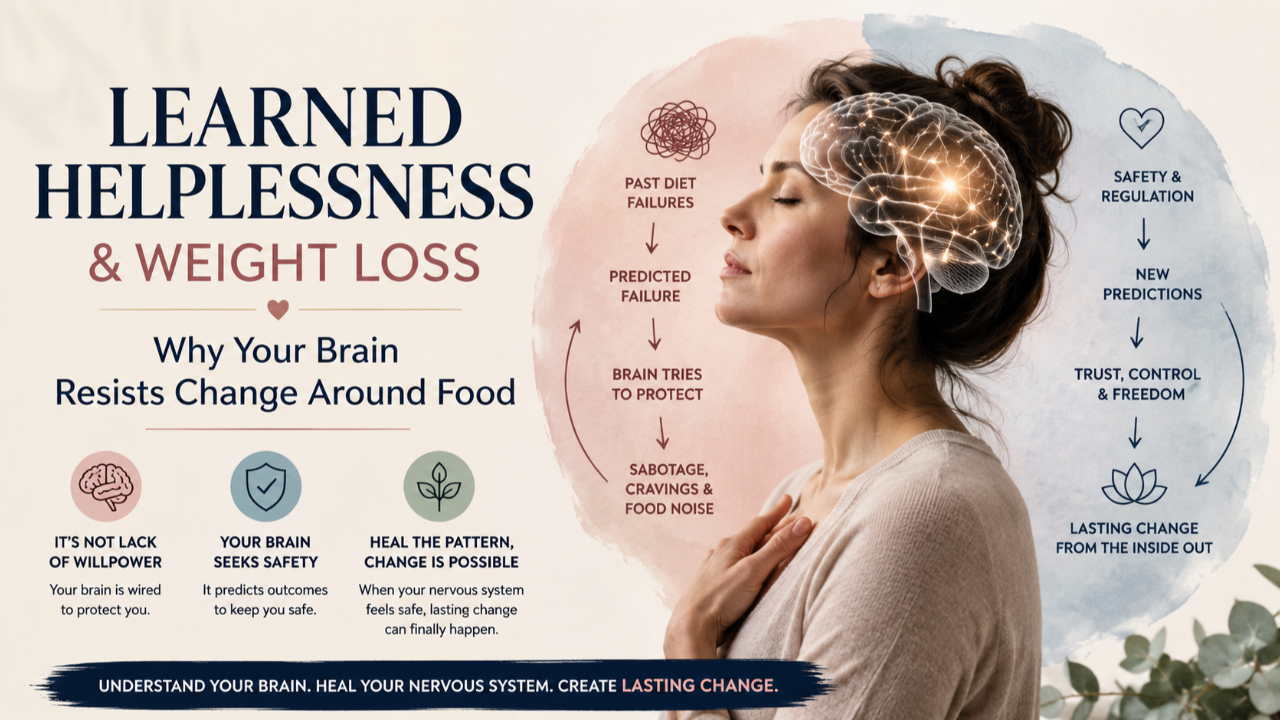
Try hard → restrict → white knuckle → “fall off” → regain weight → shame yourself
Your brain eventually stops seeing dieting as a smart calculation. It starts seeing it as a threat.
Once the brain registers that calculation, it starts to change its signals to conserve this “waste of energy”. It’s going to shortcut your dieting efforts because it believes those efforts are an inefficient equation. Dieting ≠ success so why put energy behind those efforts!
The brain has myriad ways to accomplish this.
Here are just a few mechanisms the brain can signal to conserve energy:
- Turning up hunger cues (food noise)
- Turning down satiety cues
- Increasing cravings
- Turning down energy, making it less desirable to move your body
Why Dieting Often Triggers the Nervous System
This is where things get deeply biological. The moment you decide to “start over” on your new diet several things happen simultaneously inside the body:
1. Your brain detects behavioral change
You are about to do something different (change your behavior)
Anything unfamiliar gets flagged for evaluation.
Your nervous system suddenly asks:
“Is this safe?”
2. You reduce energy intake
All diets involve a reduction in caloric intake.
To your biology, that can register as:
“Resources are becoming scarce.”
3. Your brain searches past evidence
Your brain searches its past file folders for any evidence of what has happened in your past.
And if past attempts ended in struggle, deprivation, bingeing, shame, or regain?
Your brain predicts failure before you even begin. So what does it do?
It attempts to protect you. Not sabotage you, but protect you.
It will do this by adjusting your experience. Hunger cues get turned up, cravings feel out of control, fullness signals go dormant..
It’s not trying to hurt you, it just wants to carry out the most effective use of its energy resources so it will short circuit the time it takes you to quit your diet.
The Body Will Always Win Over Willpower
This is why mindset alone doesn’t work. You can repeat positive affirmations and goal setting mantras like:
“I trust myself around food.”
But if your nervous system does not feel safe around food? Your body will reject the thought before your conscious mind can integrate it. In neuroscience, this is what we call bottom-up processing. Your nervous system is constantly scanning for cues of:
- safety
- danger
- belonging
- deprivation
- stress
- predictability
And it processes those cues a million times faster than conscious thought.
Which means: You cannot out-think a dysregulated nervous system.
Read that again. Because most people spend decades trying.
Why Smart, Successful People Feel “Out of Control” Around Food
One of the biggest misconceptions about emotional eating is that it happens because someone lacks discipline. I have found this to be categorically incorrect. The women I work with are incredibly high-functioning, many top of their field or managing a bustling household or caring for aging parents. Doctors, Teachers, Therapists, Executives, Mothers, Caretakers, Health professionals.
People who can manage careers, families, crises and responsibilities with extraordinary capability…but feel powerless around food. That contradiction creates enormous shame.
A recent client of mine told me:
“I am a psychiatrist in private practice for goodness sake… I’m ashamed I haven’t been able to fix this myself.”
Another wrote:
“Sometimes it feels like I am on autopilot, eating whatever I think will make me feel better in the moment like I’m not even in control of it.”
That’s not laziness. That’s nervous system conditioning.
The Real Cost of Learned Helplessness
Over time, learned helplessness spreads far beyond food.
It affects:
- relationships
- self-worth
- parenting
- motivation
- health behaviors
- emotional regulation
- confidence
- career decisions
Because once the brain learns: Effort doesn’t change outcomes…it conserves energy by reducing effort altogether. That’s why so many people begin to feel numb, disconnected, exhausted, hopeless, or emotionally flat. Not because they don’t care. Because their system adapted.
Time For The Good News: The Brain Can Learn Something New!
This is the part I wish everyone understood: The same brain that learned helplessness can re-learn empowerment. That’s the power of neuroplasticity!
When the nervous system begins experiencing consistent cues of safety, predictability, self-compassion, and regulation, the brain updates its previous predictions. And slowly, behavior changes begin to feel less forced.
Not because someone finally found the perfect meal plan. Because the body stopped perceiving change as danger. This is how we move from fighting the body to alignment with the body. When the nervous system gets on board, everything gets easier! This is what freedom and peace around food feels like.
Healing Is Not About Putting More Controls On Yourself
Most people approach change by trying to force themselves into it. More rules. More pressure. More tracking. More discipline. More promises to finally “get serious this time.” But sustainable transformation rarely happens through internal warfare.
Real change happens when the nervous system no longer feels the need to protect you in the same ways. When the body begins to feel safe enough to pause before reacting, choose differently without force, tolerate discomfort without spiraling, stay present instead of escaping, and slowly rebuild trust in itself again. That is the work beneath the food.
And it’s also why so many traditional approaches fail. They focus on changing behavior without addressing the biology and nervous system patterns driving the behavior in the first place.
If You’ve Been Struggling, Read This Carefully
Your patterns make sense. In neuroscience we call these, Adaptive Survival Strategies. In other words, you got this way for a reason! A good one, in the eyes of the nervous system. That does not mean you’re doomed to stay there. But it does mean your body deserves understanding, not punishment.
Because shame never creates safety.
And without safety, the nervous system will always pull you back toward familiar survival patterns. Even if those patterns frustrate and infuriate you.
What’s Next?
If this is resonating with you, if you’re starting to realize there’s more to this than you’ve been told, then I’m inviting you to take the next step in this process.
I break all of this down inside my free workshop, Master Your Weight Loss. In it, I’ll show you why traditional weight loss advice has it backwards, what’s actually driving your patterns with food, and how to create lasting change.
If you’re anything like the thousands of women I’ve already worked with, you don’t just want to lose weight. You want to feel free from a lifetime of food obsession, frustration and turmoil around food. And that requires a different approach.
I dive even deeper into these topics on the Brain Powered Weight Loss Podcast, where I unpack the science, the stories, and the strategies behind sustainable change and weight loss that actually lasts.
🎧 Listen now on your favorite platform: Search Brain Powered Weight Loss Podcast or click here
💬 Let’s Keep the Conversation Going
If something in this post resonated with you, you're not alone and you don’t have to figure it out alone either.
As a licensed psychotherapist, behavior change specialist, and expert in the neuroscience of lasting transformation. I've helped thousands of people, regulate their nervous systems, and finally gain control over food and their bodies, not through willpower, but through proven, science-backed methods, offering a path to sustainable change that actually works, not just for your body, but for your whole self.
👉 Ready for deeper support? I welcome hearing from you. Send me an email: [email protected].
And if you're looking for a safe place to heal your relationship with food, body, and self, you're in the right place. I'm so glad you’re here.